
Can you learn Dutch with Duolingo alone?
You’ve started working at your new job, settled into your home, and have established a daily routine. Life in the Netherlands has begun. Once everything is up and running, the question “Should I learn Dutch?” probably arises. If you think you should (or simply want to learn the language), but don’t feel like spending a fortune, Duolingo quickly pops up. A colorful, free, quick, and fun learning tool. But can you actually learn Dutch with Duolingo alone?
Is Duolingo enough? Well, that depends on your goal
Duolingo has been getting quite a bit of criticism lately. Reactions to the app seem to fall into two camps: it’s great, or it’s terrible. Time to take a more nuanced look at the famous green owl and his comically forceful reminders. In this blog article, we’ll lay out the pros and cons for you.
Curious to get a sneak peek? Duolingo is great for basic vocabulary and building a daily habit, and a good choice if you want to play with the language a bit. What it isn’t is a complete method if you want to actually live your life in the Netherlands. The app simply wasn’t built to guide you to a solid, everyday Dutch level with a clear plan.
What Duolingo does well
Let’s cut our feathered friend some slack and start off with the credits he deserves. For Dutch learners, Duolingo is generally useful for the following reasons:
- The app helps you build a daily habit. The streaks and gamification make it easier to touch Dutch every day.
- Basic vocabulary: you’ll pick up lots of words and simple phrases.
- It’s free (or cheap), can be used on your phone, and doesn’t give you that unpleasant “I have to study” feeling.
As a supportive app, that’s great. Even if you have only 5 minutes while waiting for the next train, you can still repeat some vocabulary. In other words: for casual practice, it’s exactly what you need.

Why Duolingo isn't enough for real-life Dutch
But when is Duolingo not exactly what you need? The answer is if your goal is mastering real-life Dutch that you can actually use on a daily basis. If you want to talk to your colleagues, GP, or child’s teacher in Dutch, you’ll quickly hit the ceiling with Duolingo. Here’s why:
- The grammar is shallow. Patterns appear, but explanation is absent and guided practice is limited.
- Unrealistic context. Many sentences are funny or random, and sure are good for a laugh. But how likely is it that you’ll ever say you’re selling your mother-in-law for a euro? Or that your horses collect teeth? Not exactly situations you’d face in daily life.
- Limited speaking and writing. Most tasks are tapping, matching, and placing in the right order instead of producing your own sentences.
- There is no feedback: with no one to correct your mistakes or answer your questions, you’re likely to develop gaps in your grammar knowledge and deal with fossilization.
- No learning roadmaps. You’ll see units and levels, but no clear plan to reach CEFR language level A2.
What a complete Dutch self-study path needs (that Duolingo doesn’t give)
If you’re serious about learning Dutch, your goal will be “I can manage my life in the Netherlands” rather than “I know a few words to express my basic needs”. However, without a clear study path, it is extremely difficult to achieve anything beyond the latter. In order to really move forward, you’ll need:
- A clear roadmap guiding you from your starting point to level A2.
- Practice across all skills: reading, listening, writing, and speaking.
- Proper grammar explanations and systematic practice.
- Real-life practice: dialogues, scripts, and assignments for work, school, GP visits, social events, and more.
- Some form of support and feedback so you’re not completely on your own.
So, should you give Dutch self-study another go?
Almost all expats who come to us for help learning Dutch have tried some form of self-study in the past, but eventually gave up. They felt they weren’t making enough progress and missed that little boost they needed from time to time. Although most people ultimately opt for one-on-one lessons, that isn’t necessarily the only right path. There are plenty of reasons to give self-study another try. For example, because you can’t commit to fixed class times, other expenses are a priority right now, or because you know you’re a true self-learner.
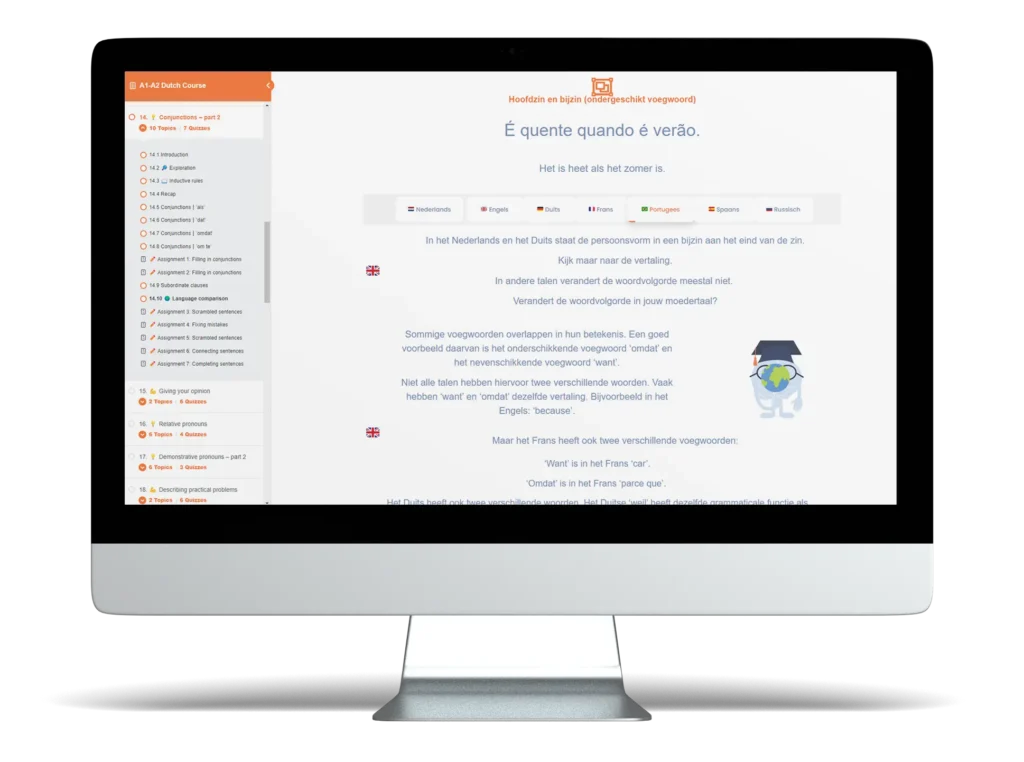
At Dutch Ready, we developed the Dutch Ready Academy to be that complete self-study backbone for expats up to language level A2.

The Dutch Ready Academy: more than just another app on your phone
Learning a language takes time and effort, as well as a carefully considered approach to achieve long-term results. On the other hand, it’s not rocket science, and definitely doesn’t need to be approached that way. That’s why at Dutch Ready, we take our own approach:
1. Personalize
In personalized learning, you as a learner play an important role in the learning process. This doesn’t only have to do with your native language, but also with your experience with learning a new language, the pace at which you learn, and the time you have available. Personalized learning tailors to your individual needs, boosting engagement and deeper comprehension.
2. Generalize
When you’re aware of the similarities and differences between your native language and Dutch, the acquisition of the latter becomes much smoother. This applies to pronunciation, vocabulary, sentence structure, etc. If there are certain things you already do well (whether or not because of your native language), or that you do intuitively, then they don’t need any attention. That’s why we use language comparisons, sound cards, and specific exercises to help you generalize.
3. Simplify
As we already mentioned: learning a new language is not rocket science. Dutch Ready also simplifies the learning process by not explaining complex grammar rules in detail, but by focusing on the essentials and making frequent use of rules of thumb. In addition, we structure our lessons from general to specific. This approach reduces cognitive load and improves efficiency and motivation.

A self-study platform that helps you actually speak Dutch in daily life
More than 170 students rewarded us with 5-star reviews for our 1-on-1 private Dutch lessons. We took the same practical approach and learning modules into our Dutch Ready Academy self-study system to help you use Dutch in daily life instead of learning just words. This is what you can expect:
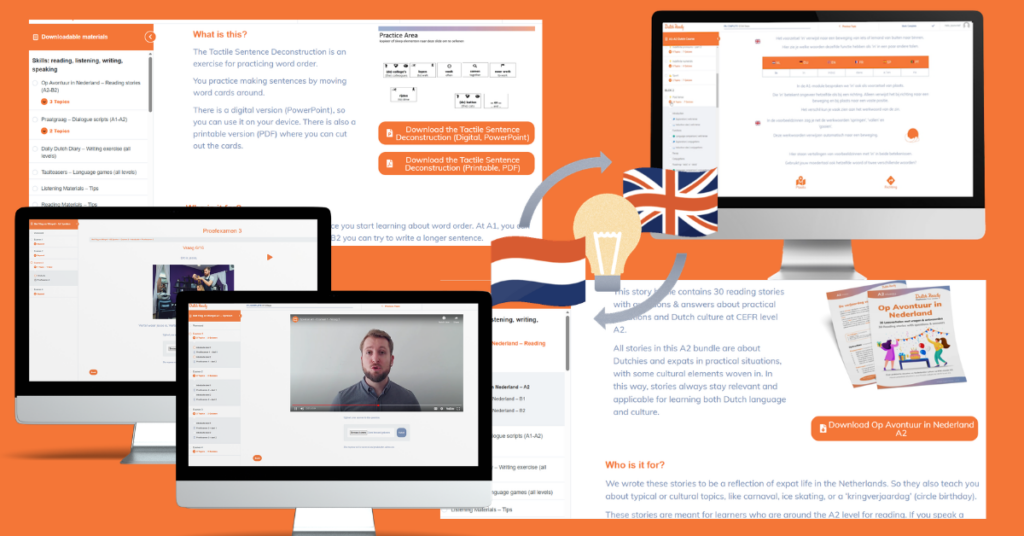
- A focus on all Dutch skills: reading, listening, writing, and speaking
- 2 comprehensive modules covering grammar and practical application to get you to Dutch level A2 (with a total of 42 grammar lessons and 29 practical lessons)
- Pronunciation & spelling module
- Practice exams at levels A1 and A2
- Supportive modules: dialogue scripts, reading stories, and more.
- A clear CEFR-based roadmap giving you insight in the skills you’ll be working on and in which order.
- Extra support in the form of bi-weekly group Q&A sessions, where you can ask all your questions.
Of course, if you have strict deadlines or special challenges, you can always opt for private online Dutch lessons.
Can you learn Dutch with Duolingo alone? Conclusion
Finally, let’s return to the initial question that was the focus of this blog post: “Can you learn Dutch with Duolingo alone?” By now, it probably is clear to you that Duolingo is a convenient choice when you just want to play a bit with Dutch and prefer a light, game-like experience. But if you’d like to reach A2 in the next 6-12 months, want to feel confident in daily life, and need a structured and affordable way to get there, a complete self-study course is for you. And of course, you don’t have to quit Duolingo. You can always keep it for those 5 minutes at the train station, or as a quick practice during your lunch break.
What's the next step?
Are you serious about learning Dutch and want more than just an app? Then check out the Dutch Ready Academy on our website here.
Not sure whether the Academy alone is enough, or if you should combine it with 1-1 lessons? Feel free to reach out to us. Tell us your level and goals, and we’ll help you choose the path that gets you to real-life Dutch.