
The most common Dutch self-study mistakes that waste months
(and how to fix them)
Learning Dutch alone but still freezing in real conversations? Discover 6 common Dutch self‑study mistakes and how a structured roadmap, feedback and pronunciation practice help you actually speak.
Does this sound familiar?
You’ve been learning Dutch on your own for months. Your vocabulary keeps growing, your language app says you’re making progress, and you’ve completed countless lessons. But then the bakery employee asks “Anders nog iets?” and your mind goes blank. If this sounds familiar, the problem is usually not your motivation or ability, but your study method. Without realizing it, many learners make common Dutch self-study mistakes that significantly slow down their progress.
In this article, we’ll look at the most common Dutch self‑study mistakes expats make when learning Dutch on their own and, more importantly, how to fix them so you stop wasting months.
Why does your Dutch self-study stall in the first place?
Learning Dutch alone has some great advantages. You can study whenever you have time, repeat difficult topics as often as you want, and choose resources that fit your learning style. However, self-study also comes with some challenges:
1. A lack of structure
2. Noboby is guiding your process
3. You receive very little to no feedback
A tutor who keeps an eye on things can immediately notice when you misunderstand a grammar rule, pronounce a sound incorrectly, or avoid speaking because you are afraid of making mistakes. When you study Dutch alone, those small problems can stay hidden for months. And mistakes like these can be hard to unlearn. This is why many learners reach a point where they know quite a lot about Dutch but still struggle to use it in daily life. They have built knowledge, but they haven’t always built the skills they actually need.
Personalize, Generalize, Simplify
The good news? Most common Dutch learning mistakes are fixable. You don’t necessarily need to study more, or switch from self-study to private lessons. You need to study more strategically. At Dutch Ready, we make learning Dutch maximum efficient by applying the principles Personalize, Generalize, and Simplify. We adapt the learning process to your individual needs, help you recognize useful language patterns and connections, and focus on the essentials so you can make faster, more effective progress.

Dutch self-study mistakes & how to avoid them
Of course, everyone’s learning journey is different. But from years of conversations with our students, we’ve noticed that they regularly make the same mistakes when studying Dutch on their own. Those are:
- Using random resources without a roadmap
- Having no feedback loop
- Skipping pronunciation until ‘later’
- Chasing vocabulary lists without structure
- Building grammar knowledge but never speaking
- Studying everything as if it is equally difficult
Sound familiar? Let’s take a closer look at them below.
1. Using random resources without a roadmap
There’s a whole bunch of Dutch learning resources available online. That sounds like a great thing, and of course it is. But it can also become a challenge.
One day you watch a video about Dutch word order.
The next day you study vocabulary about food.
Then you download another app because someone recommended it.
After a while, you have collected many resources but have no clear idea what to study next. Learning a language is a process. Some topics naturally build on others.
A beginner needs a different approach than someone who already has a B1 level. You need to know what skills are important at each stage and in what order to develop them. A clear roadmap to study Dutch alone prevents you from spending months reviewing things you already know or jumping into topics you are not ready for yet.

2. Having no feedback loop
When you study alone, it is easy to repeat the same mistakes again and again. Maybe you always use the wrong word order. Maybe you pronounce a sound incorrectly. Maybe you misunderstand a grammar rule and build new sentences based on that mistake. After a while, incorrect knowledge becomes hardwired in your brain. It’s a process we call fossilization.
Feedback doesn’t necessarily come from a teacher. It can also come from speaking partners, or structured exercises with explanations. The important thing is that your learning process includes a way to notice and correct mistakes.
3. Skipping pronunciation until 'later'
Many learners are eager to learn new words and form their own sentences, and think pronunciation is something they can fix at a later stage. But the truth is that pronunciation habits, just like all other common Dutch learning mistakes, become harder to change over time. After all, your brain starts treating your version as normal. Your pronunciation doesn’t have to be perfect from day one. In fact, that’s practically impossible. The goal is not to sound like a native speaker immediately, but to build the right habits early.
Dutch has several sounds that are challenging for many learners. The Dutch g sound is a famous example, but vowels and diphthongs such as ui, eu, and ij also prove to be challenging for most Dutch learners. Our blog about improving your Dutch pronunciation explains some of the biggest pronunciation challenges and how to approach them.
4. Chasing vocabulary lists without structure
Learning vocabulary feels productive. You can see your progress clearly: 15 new words today, a total of 50 new words this week, 200 words learned, etc. The problem is that words do not work alone. Without knowledge about sentence structure, you might recognize many words, but wouldn’t be able to create a natural sentence.
Vocabulary needs grammar as a framework. It’s the structure behind the words that allows you to communicate. A better approach is to learn vocabulary together with sentences, grammar patterns, and real-life situations. Instead of memorizing isolated words, learn how Dutch is actually used.

5. Building grammar knowledge but never speaking
You listen to podcasts, watch videos, read articles, and complete exercises in apps. This is useful because your brain needs exposure to the language. But there is a big difference between recognizing Dutch and producing Dutch. One of the most common mistakes when learning Dutch on your own is spending almost all your time consuming Dutch. You might understand a sentence when someone says it, but that does not automatically mean you can create a similar sentence yourself. Speaking is a skill. And like every skill, it needs practice.
The longer you avoid speaking Dutch, the more difficult it becomes
If you wait until you “know enough Dutch” before speaking, that moment might never come. The longer you avoid speaking, the harder it becomes to turn passive knowledge into active language. A simple solution is to include speaking from the beginning. This does not mean having deep conversations immediately. Start small: repeat sentences aloud, describe your day, answer questions, or practice short dialogues. You can also read our blog about fear of speaking Dutch for more support.
6. Studying everything as if it is equally difficult
Many learners treat Dutch as if every part of the language requires the same amount of attention. But that is not necessary. Your native language already gives you advantages. Depending on your background, some Dutch words, sounds, or grammar structures may feel very familiar. For example, speakers of English, German, or Scandinavian languages may recognize many Dutch words more easily than speakers of languages with completely different roots.

A personalized approach is key
The opposite is also true. Some parts of Dutch might require extra attention because they do not exist in your native language. This is why a personalized approach is important. Instead of spending equal time on everything, focus more on the areas where you actually need improvement. At Dutch Ready, we call this Generalization: understanding which parts of Dutch you can connect to knowledge you already have and which parts need specific practice.
What does fossilization actually mean and why is it so important to be aware of?
We’ve already mentioned this word: fossilization. In language learning, fossilization describes a situation where certain language mistakes become stable and difficult to change, even after continued exposure to the language. For example, a learner might consistently use incorrect word order or pronounce a sound in a particular way. Over time, this incorrect version becomes automatic.
Team up with your brain and set the correct default from the start
It happens because the brain naturally tries to create efficient patterns. Once a pattern feels familiar, it becomes the default option. Research in second-language acquisition has explored this phenomenon extensively. Therefore, the earlier you as a Dutch learner notice patterns that need improvement, the easier they are to adjust.
This is why a good learning method includes practice, correction, and repetition instead of only exposure.

How to study Dutch alone the smart way?
If you want to study Dutch alone successfully, you need more than motivation. You need a system. At Dutch Ready, we apply three principles to make learning more efficient: Personalize, Generalize, Simplify.
Want a ready‑made roadmap for A0–A2 self‑study?
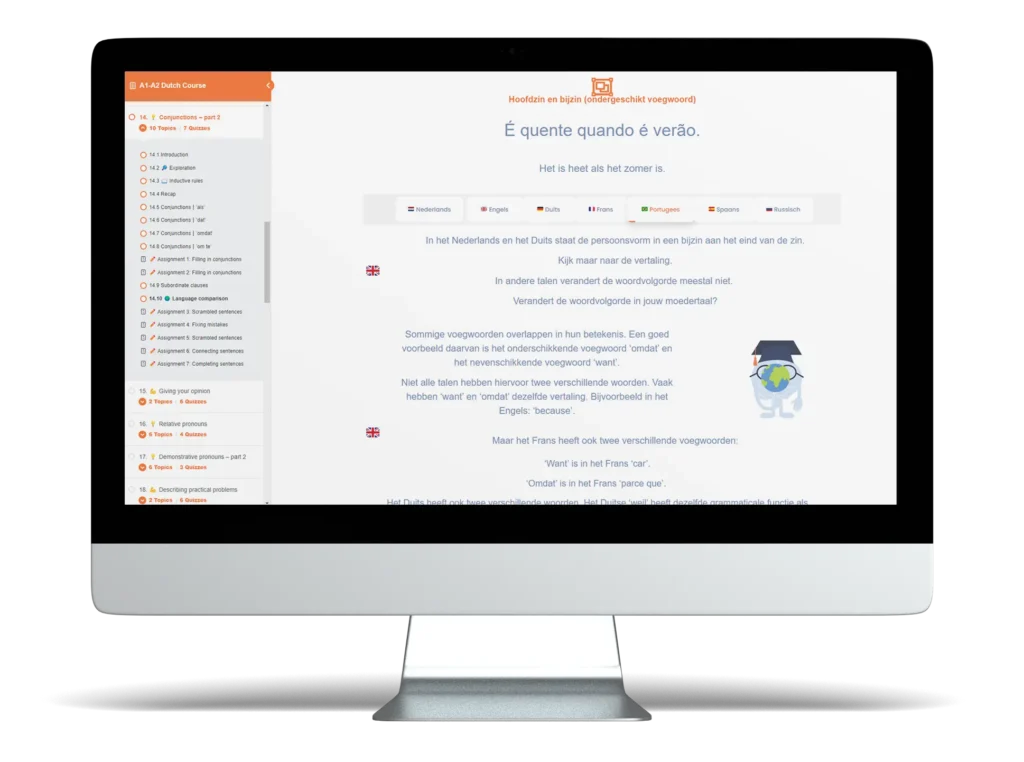
The Dutch Ready Academy gives you step‑by‑step grammar, pronunciation drills and practice tasks you can follow on your own.
→ Click here to see what’s inside the Academy.
1. Personalize
Every learner starts from a different point. Your native language, previous language-learning experience, available time, and personal goals all influence how you learn Dutch. A good self-study method should adapt to you, not force everyone through exactly the same path. For example, someone who already speaks German may need less focus on certain vocabulary similarities but more attention to pronunciation. Someone with no experience learning languages may need more guidance with study techniques.
2. Generalize
Dutch becomes easier when you understand connections. Which parts of Dutch are similar to your own language? Which grammar patterns can you recognize? Which sounds need extra practice? By making these connections, you avoid wasting time studying things you already understand and can focus your energy where it matters most. This is why we use language comparisons, sound comparison cards, and targeted exercises in the Dutch Ready Academy.
3. Simplify
Learning Dutch does not need to feel like solving a complicated puzzle. A good method simplifies the process by focusing on the essentials first. Instead of overwhelming you with every possible grammar detail, it helps you understand the patterns that allow you to communicate in daily life.
That means learning Dutch step by step, from general concepts to more specific situations.
The Dutch Ready Academy was designed around this idea: giving expats a structured self-study path towards Dutch CEFR level A2, with grammar lessons, practical exercises, pronunciation practice, and opportunities to apply what you learn.

What's your next step?
If you recognize these Dutch self‑study mistakes, don’t start over from zero.
Want a structured self‑study path?
Check out the Dutch Ready Academy for a complete A0–A2 roadmap, pronunciation practice and feedback‑friendly exercises.
Need to move faster (for exams, visa, or work)?
Send us a message with your level and goal. We’ll tell you honestly whether self‑study is enough or whether some 1‑on‑1 lessons will save you months.
Not sure whether self-study is enough for your situation, or whether adding some 1-on-1 Dutch lessons would help you progress faster? Feel free to reach out. Tell us your level and goals, and we’ll help you choose the approach that fits you best.