
How do you learn Dutch with learning difficulties?
What actually helps if you have ADHD, autism, or dyslexia, and how to choose a setup that fits the way you learn?
Maybe this situation feels familiar. You’re sitting in a classroom with twelve other students. The teacher is explaining something, but before you’ve fully understood it, they’ve already moved on to the next point. You try to keep up, but somewhere along the way, you lose track. So you nod, write a few notes, and hope nobody asks you a question. You went home that evening and told yourself you’re not a language person.
Experiences like these lead many Dutch learners to wonder “How do you learn Dutch with learning difficulties such as ADHD, autism, or dyslexia?”
What makes learning Dutch extra challenging if you have learning difficulties?
→ Sentence order, sounds and spelling
Learning Dutch with ADHD
→ Accountability and planning are key to progress
Learning Dutch with autism
→ How clarity and predictability help
Learning Dutch with dyslexia
→ Become familiar with spelling by focusing on speaking and listening first
The best option isn't the same for everyone
You may need Dutch for work, daily life, or the inburgering exam. Perhaps you have a deadline, or maybe you simply want to feel more confident speaking with the people around you. But one question keeps coming back: what’s the best way to learn Dutch when you have a learning difficulty
Should you study on your own, so you can learn at your own pace? Or would you do better with a tutor, even if classrooms haven’t worked well for you in the past? If you have ADHD, autism, dyslexia, or another learning difficulty, this choice can make a big difference.
Why the right approach makes learning Dutch with learning difficulties much easier
For many neurodivergent learners, the most effective approach isn’t choosing between independent study and lessons, but finding the right balance between personal guidance and structured practice. We’re not psychologists. This article isn’t medical advice, but offers insight into what we’ve learned from years of helping people who learn in different ways, and how a tailored learning approach can make studying Dutch much easier. Learning Dutch with learning difficulties isn’t about working harder. It’s about finding the right learning approach.

Why does traditional language learning fail so many capable students?
Many people with ADHD, autism, dyslexia or other learning difficulties think they’re simply ‘bad at languages’. In reality, that’s often not the case. Traditional language courses are designed for the average learner, but not everyone learns in the same way.
1. The pace is set by the group, not by you
In a group course, everyone has to move at roughly the same speed. If you need a little more time to understand a grammar rule or remember a new word, the lesson doesn’t stop. The class simply moves on. Of course, the opposite is also true: spending too much time on a topic that’s crystal clear to you can feel like a huge waste of time.
2. Missing just one class can feel like an unbridgeable gap
Language learning also builds on previous lessons. If you miss an important explanation because you couldn’t attend a class, the next lesson often becomes harder to follow. Simply because understanding today’s topic requires understanding the previous one.
Situations like these often make you hope even more that the tutor won’t ask you a question. At the same time, you’re feeling frustrated, because the already limited speaking time in class is getting even less. You start to feel like you might as well have just spent the evening watching Netflix.
3. A learning difficulty is often a mismatch, not a lack of ability
Many Dutch learners believe they’re simply ‘bad at languages’. This conviction damages their motivation and self-confidence. In reality, they’re not bad at Dutch. They were just taught in a way that didn’t suit how they learn best.
Maybe the lessons moved too quickly. Maybe there wasn’t enough repetition. Or perhaps there were too many distractions in a busy classroom. That doesn’t mean you can’t learn Dutch. It often means you need a different way of learning.
A combination of personal guidance and structured practice
That’s why it’s worth thinking carefully about how you want to study before you invest more of your time and money without getting the result you want. Finding a method that facilitates learning Dutch with learning difficulties is key. Many Dutch learners with ADHD, autism, dyslexia or other learning difficulties benefit from combining personal guidance with structured practice. Instead of figuring everything out alone, they receive feedback during their lessons and continue practicing independently between lessons.
What happens when you don't have to figure out everything alone?
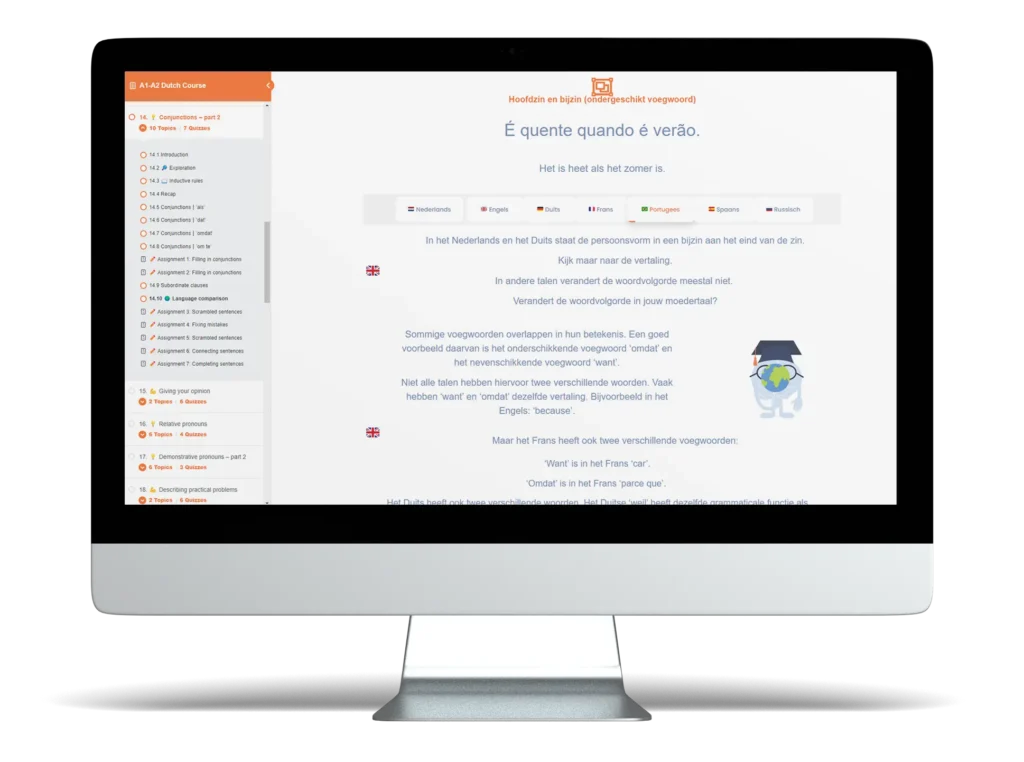
Many expats with learning difficulties who want to learn Dutch find it hard to decide where to start or what to focus on next. At Dutch Ready, we support you with a clear learning path, practical 1-1 Dutch lessons adapted to your goals and needs, and tailored feedback. Personal guidance, combined with the structure of our learning materials (included in all lesson packages), has already helped many neurodivergent students, and shown them that they, too, are perfectly capable of achieving their Dutch learning goals.
The ideal lesson frequency and duration differ from person to person. Together, we’ll find a schedule that matches your goals, learning style and availability.

What makes Dutch extra hard when learning is already hard?
Every language has its challenges. But Dutch has a few characteristics that can make learning even more difficult if you have ADHD, autism, dyslexia or another learning difficulty.
1. Dutch makes you wait for the important information
In Dutch, the most important part of the sentence often comes at the end. For example:
“Ik wil vandaag mijn oma bezoeken.” (“I want to visit my grandmother today.”)
“Weet je dat hij volgend jaar in Amsterdam gaat studeren?” (“Do you know he’s going to study in Amsterdam next year?”)
You hear the complete sentence, or most of it before you finally hear the verb. Something similar happens with separable verbs, where you hear the first part of the verb at the beginning of the sentence, and the second part at the very end. For example:
“Ik maak mijn badkamer morgen schoon.” (“I’m going to clean my bathroom tomorrow.”)
(schoonmaken = to clean)
Your brain has to remember the beginning of the sentence while you’re still listening to the rest. And that means you have to rely on your working memory: the part of your brain that temporarily holds information while you’re using it. If working memory is already a challenge for you, Dutch sentence structure can feel much harder than it does for other learners.
2. Sounds and sound combinations you hadn't practiced before
Dutch contains some sounds that don’t exist in many other languages. Think of the g/ch, or vowel combinations such as ui, eu, and ij. To many students, they all sound unfamiliar, even if they’ve learned other foreign languages before. Mastering these sounds requires knowledge of the specific mouth positions you need for a correct pronunciation, and lots of practice.
3. The system of single and double vowels
Dutch pronunciation and spelling are closely intertwined, and the rules are pretty straightforward. Once you’ve mastered the pronunciation of a letter or combination of letters, you’ll be able to apply it correctly in most cases. Nevertheless, the system of open and closed syllables, which forms the basis for the pronunciation of single and double vowels, often causes confusion. Sometimes words have the same vowel, yet they sound very different. Take a look at some of the examples from our Pronunciation & Spelling Module:

bomen
(bo-men)
- ThePlus Audio
 trees

koffer
(kof-fer)
- ThePlus Audio
suitcase

rennen
(ren-nen)
- ThePlus Audio
to run

eten
(e-ten)
- ThePlus Audio
to eat
If reading is already challenging because you have dyslexia or another learning difficulty, this can become even more frustrating. You’re trying to recognize unfamiliar words, understand their meaning and pronounce them correctly at the same time. That’s a lot for your brain to process.
Learning Dutch with ADHD: accountability and planning as the keys to success
ADHD is a disorder that causes challenges with executive functioning. That can lead to difficulties with organization, focus, and attention span. Many people with ADHD don’t struggle because they can’t learn Dutch. They struggle because getting started, staying focused and studying consistently is difficult. You might understand today’s lesson perfectly, but then not study again for two weeks. Many learners find that regular lessons provide the accountability they need, while short, structured practice between lessons helps them build consistent study habits.
Short study sessions work better than long ones
Studying Dutch for four hours on a free Sunday often sounds like a good plan. In reality, most people learn more from four one-hour sessions spread throughout the week. That’s because languages are built through repetition. You’ll need to see and use the same grammar and vocabulary several times before they become automatic. Short, regular study sessions make that much easier, especially if you have ADHD
Don't keep all the planning in your head
If organizing and remembering tasks is difficult, don’t rely on your memory alone. Let your environment help you. Use reminders on your phone. Reserve fixed study times in your calendar. Set a timer before you start. Or plan a weekly lesson with a tutor who expects to see you. Some learners also find body doubling helpful: studying alongside someone else, even if you’re both working on different things. Strategies like these make it easier for you to get started and keep going.

Make it easy to begin
And to go into a little more detail about getting started: for many people with ADHD, this is the hardest part. That’s why it helps to remove as many small obstacles as possible.
- Plan fixed study moments and set reminders
- Decide in advance what you’ll study during your next session
- Keep your study materials together
The fewer steps you have to take before you begin, the more likely you are to actually start studying. If you’d like more practical ideas, we’ve written a separate guide about staying motivated and accountable while learning Dutch on your own.
Learning Dutch with autism: build a structure that works for you
Autism is a neurodevelopmental condition that affects how you function, communicate, and interact. Many learners with autism enjoy structure, clear explanations and predictable routines. That’s good news, because those are exactly the things that can make learning Dutch easier. Not every classroom offers that. Fortunately, there are other ways.
Predictability helps you focus on the language
When you know what to expect, you can spend your energy on learning Dutch instead of trying to work out what’s going to happen next. That’s why many autistic learners find it helpful to study at the same time each week, following the same lesson structure and using familiar materials. A self-study course can work well because every lesson follows a clear pattern, and you can study at your own pace without feeling rushed.
Clear explanations make learning easier
Some language courses expect you to learn mainly through conversation and exposure. For some learners, that works well. Others prefer to understand the rules first. Dutch is actually a language with many clear grammar patterns. Once you understand the rule, applying it often becomes much easier.
That’s also how we teach at Dutch Ready. We explain the rule first, discuss the most important exceptions and then practice it step by step. If you’d like to see what that looks like, our overview of basic Dutch grammar rules is a good place to start.

Choose a learning environment that feels comfortable
Learning a language already asks a lot from your brain. If you also have to deal with a noisy classroom, unexpected changes or the pressure to answer quickly, learning becomes even harder. Independent practice can reduce many of those distractions.
Many autistic learners appreciate predictable learning materials they can revisit at their own pace. When these are combined with one-on-one Dutch lessons and a tutor who adapts the pace and structure to their needs, they create a learning environment that many find both comfortable and effective.
Learning Dutch with dyslexia: focus on speaking and listening first
Dyslexia is a learning disability that disrupts the way your brain processes written language. It affects everyone differently. Some people mainly struggle with reading, while others find spelling the biggest challenge. Whatever your experience, it’s important to remember that communicating effectively in Dutch is not the same as being able to spell every word perfectly.
Learn the pronunciation before the spelling
You don’t need to know how to spell a certain word before you can use it in a conversation. Many learners with dyslexia find it easier to hear a word, practice saying it and use it in a sentence before learning how it’s written. Once the word already sounds familiar, the spelling often becomes easier to remember.
Our sound comparison cards compare Dutch sounds with the sound of English or your own language (the cards are available in 16 different languages). That makes it easier to hear and pronounce difficult sounds. Our pronunciation and spelling module, developed together with a speech therapist, builds on the same idea with videos, audio and guided pronunciation practice. This module is part of our collection of Dutch learning materials, which is included in all lesson packages.
If pronunciation is one of your biggest challenges, you may also find our guide about how to improve your Dutch pronunciation helpful.

Dutch pronunciation is often more consistent than English
As we mentioned earlier, despite the fact that the spelling and pronunciation of the Dutch vowels can sometimes be confusing, Dutch spelling is actually surprisingly logical. If you take English, for example, you’ll find many words that don’t follow the same spelling rules. The ea combination sounds different in the words bear, sea, and great.
Dutch is generally more consistent. Once you’ve learned how combinations are pronounced, you’ll find that this pattern usually stays the same.
Use tools that support the way you learn
Don’t hesitate to use tools that make learning easier. Listening to audio, repeating lessons, slowing down videos or reading while listening at the same time can all help you learn more effectively.
At Dutch Ready, we offer different types of learning materials. Some focus on video, others combine video and text, and some are text-based. You can repeat every lesson as often as you like, giving yourself the time you need to practice.
If you know that audio support is important for you, tell your tutor from the start. Together, you can choose materials and exercises that match the way you learn best.
Independent practice is valuable, but guidance makes the difference
Studying independently has clear advantages. You can learn at your own pace, repeat lessons as often as you need and study when you feel most focused. For many learners, especially those who have struggled in traditional classrooms, that flexibility can be a huge relief.
But flexibility alone isn’t always enough. If you’re learning Dutch and have learning difficulties like ADHD, autism, dyslexia, the biggest challenge is often not working hard enough. It’s knowing what to practice, recognising your mistakes and staying on track over time.

A tutor who understands how you learn
Learning becomes much easier when your tutor adapts to you instead of expecting you to adapt to the lesson. At Dutch Ready, we have tutors with experience teaching neurodivergent learners, including students with ADHD, autism and dyslexia. When you tell us what helps you learn best, we take that into account when matching you with a tutor.
Adapting doesn’t necessarily mean completely different lessons. Often it’s the small adjustments that make the biggest difference: explaining grammar in another way, slowing the pace when needed, building in more repetition or giving you extra time to process new information.
Guidance during lessons, structure between lessons
Learning doesn’t end when the video call closes or you leave the classroom. Between lessons, you’ll continue practicing with our learning materials in the Dutch Ready Academy, which is included in all lesson packages. Your tutor can recommend exactly which lessons, exercises and revision activities fit your learning goals, so you always know what to focus on next.
This combination of personal guidance and structured self-study gives you the best of both worlds. During your lessons, you receive explanations, feedback and encouragement. Between lessons, you can practice independently with clear, structured materials at your own pace.
Start with a plan that fits the way you learn
Learning Dutch with learning difficulties doesn’t have to be frustrating. Do you think private Dutch lessons may suit you? Book a kick-off (level check and test lesson), and let’s find that out together! In the personal level check we’ll identify your strengths and the areas that need the most attention. Based on your goals and learning style, we’ll carefully match you with a tutor and create a clear learning plan towards your next milestone, whether that’s passing an exam or becoming more confident in everyday Dutch.
During your first lesson, you’ll get to know your tutor and experience their teaching approach for yourself. If you decide to continue, you’ll receive ongoing feedback during your lessons and structured practice through the Dutch Ready Academy, which is included in every lesson package.
Are you ready to start learning Dutch in a way that works for you?