
Can you pass Dutch exams with self-study only?
Find out how realistic it is to prepare for A2/B1 Dutch on your own
You’ve been studying Dutch for a while. You’ve learned new words, practiced grammar, and you actively try to understand Dutch people, even when they speak at full speed. But as your exam date gets closer, a question keeps popping up: “Can I really pass my Dutch exams with self-study only, or am I kidding myself?”
Maybe you are learning Dutch alongside a busy job. Maybe you have a limited budget and cannot afford regular lessons. Or maybe you simply enjoy learning independently and want to create your own study plan. Whatever your reason, you are not the only learner asking this question. So let’s find out whether self-study is enough to pass your Dutch exams, or if you need extra guidance to succeed.
Can you pass A2 Dutch with self-study only?
→ Yes, you usually can if you follow a structured plan.
Can you pass B1 Dutch with self-study only?
→ Sometimes, but most learners need extra speaking practice and feedback to feel confident.
A realistic goal for many learners
Passing an A2 Dutch exam through self-study is feasible for many. Passing a B1 Dutch exam through self-study is possible too, but usually requires more preparation and feedback, as well as more opportunities to actively practice your language skills. So before you decide whether self-study is the right approach for you, let’s take a look at what the exams actually test and what you need in order to succeed.
What do the A2 and B1 Dutch exams actually test?
Both A2 and B1 are language levels defined in the Common European Framework of Reference for Languages (CEFR). The CEFR describes what learners can do in a language at different stages, from beginner (A1) to proficient (C2).
Regardless of the language level, Dutch exams test four different language skills:
- reading (lezen)
- listening (luisteren)
- writing (schrijven)
- speaking (spreken)

Civic integration: inburgering and self-study
For many other expats in the Netherlands, A2 or B1 exams are connected to the civic integration process, or in Dutch known as inburgering. Depending on your situation, you may need to complete Dutch exams as part of your integration requirements. In fact, the majority of the Dutch Ready students enrolls with us for that reason. The official information about the Dutch civic integration system can be found here. If you’re considering self‑study for inburgering, it’s extra important to know exactly which level (A2 or B1) DUO expects from you and by when.
Are you taking the A2 or B1 Dutch exam?
If you are required to take an exam as part of your integration process, you have no choice in the matter. The letter you received from DUO determines your integration deadline and language level (A2 or B1). You can always check this by asking IND/DUO directly. If you want to take the exam for other reasons, like showing an employer your ability, then you’re free to pick your own goal level.
What’s the difference between A2 and B1?
If you are preparing for an A2 Dutch exam, your goal is to become an independent basic user of Dutch. You should be able to understand common phrases, communicate in familiar situations, write simple messages, and talk about everyday topics. If you are preparing for a B1 Dutch exam, the expectations are higher. You need to understand more complex texts, express your opinions, explain experiences, and communicate more spontaneously.
This difference is important because self-study works differently at each level. Now, let’s take a closer look at self-study at both levels.

Can you pass the A2 Dutch exam with self-study only?
The short answer is: yes, you can. Many learners successfully reach A2 through independent study. At this level, your main goal is to build a strong foundation: vocabulary, grammar, pronunciation, and confidence with everyday communication. However, Dutch A2 self-study does not mean opening a grammar book once a week and hoping for the best. To pass an A2 Dutch exam, you need a structured approach. That means you need to:
- learn the most important vocabulary for daily situations;
- understand basic Dutch grammar;
- practise listening regularly;
- improve your pronunciation;
- write short texts;
- practice speaking, not only reading and listening.
Speaking practice often gets overlooked
What we hear from many of our students is that they underestimate the last point.
They spend months learning grammar and studying vocabulary lists, but they rarely speak Dutch out loud. Then, during the speaking exam, they know the answer in their head, but they just can’t get it out, or fail to do so quickly enough.
First the foundation, then the details
The good news is that A2 is a level where consistent practice can make a very big difference. At Dutch Ready, we often compare learning Dutch to building a house. Before you can add details, you need a strong foundation. The A0 to A2 journey is about creating that foundation: learning how Dutch works and becoming comfortable with everyday communication.

What does self-study at A2 need to include?
If you want to pass an A2 Dutch exam with self-study, you should make sure to include four essential elements:
- A clear learning structure
- Pronunciation practice
- Speaking practice
- Practice exams
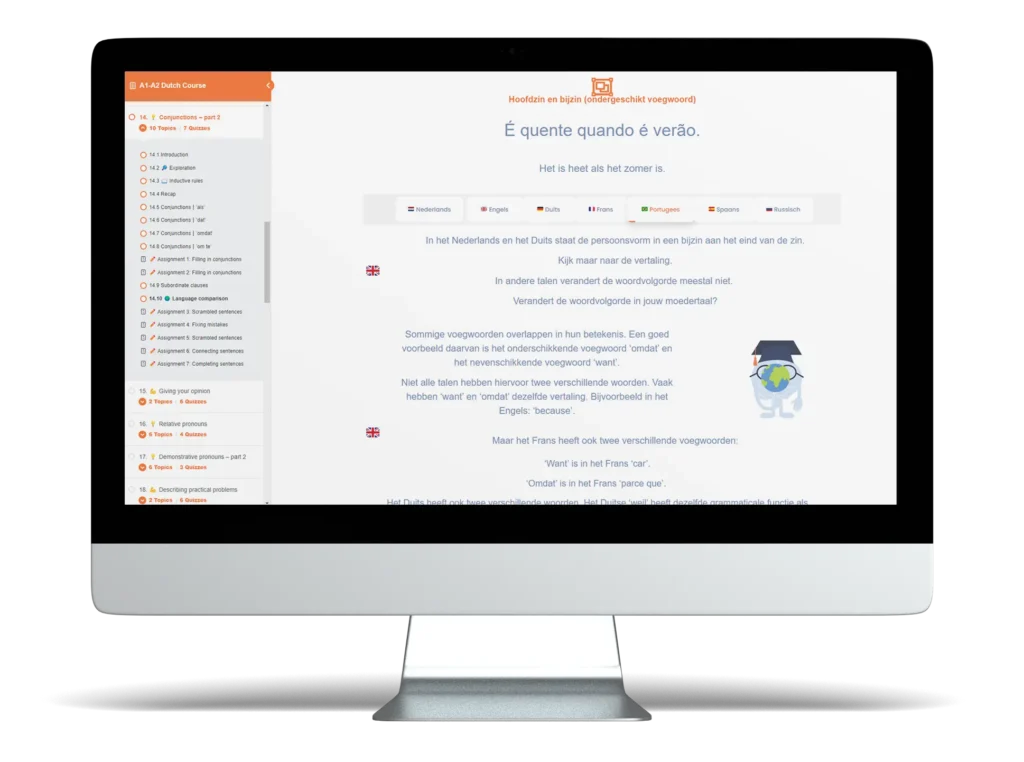
If you’ve decided to prepare A2 Dutch with self‑study, you don’t have to design everything from scratch. The Dutch Ready Academy gives you:
- A clear A0–A2 roadmap based on the CEFR
- Grammar lessons plus practical exercises for daily life
- Pronunciation and spelling practice for tricky sounds (ui, eu, g)
- A1 and A2 practice exams, plus an A2 and B1 video exam strategy course
- Extra materials like dialogue scripts and reading stories
So you can focus on studying instead of figuring out what to study next.
1. A clear learning structure
There are a vast number of resources available to help you study on your own. YouTube alone is flooded with countless videos on learning Dutch. But what seems like a luxury actually makes it harder to get started with a structured approach to learning. One of the biggest challenges of Dutch A2 self-study is knowing what to learn and when.
Consuming Dutch is not the same as really learning Dutch
Without a clear plan, you’ll find yourself jumping between random topics. One day a grammar video, the next day some new vocabulary, a day later a random listening exercise. What you’re actually doing is consuming Dutch culture without really paying proper attention to it. You could almost compare it to building a house by adding bricks, without a foundation or a plan. A good Dutch self-study programme should guide you from beginner topics towards exam-level skills.
2. Pronunciation practice
Good pronunciation doesn’t mean speaking like a native speaker and losing your accent completely. When working on your Dutch pronunciation, the goal is making sure people understand you. Sounds like ui, eu, and g/ch prove to be challenging for many learners. However, the sooner you start your pronunciation practice, the easier speaking will become later.
3. Speaking practice
Speaking is often the most difficult skill to practise alone. That’s partly because you can’t improve your speaking by only studying grammar rules. Therefore, we always advise our students to speak Dutch as regularly as possible. And the good thing is that you don’t always need a speaking partner. You could try to:
- describe what you are doing;
- answer speaking questions out loud;
- practise conversations with a language partner;
- record yourself and listen back.
Even five minutes of speaking practice every day can help you become more comfortable.

4. Practice exams
Are you ready to take an exam once you’ve reached level A2 in Dutch? Well, to be frank, not really yet. That’s because knowing Dutch is different from knowing how to take a Dutch exam. Therefore, be sure to always include specific exam preparation in your Dutch A2 self-study program. Practice exams help you understand:
- what type of questions you will get;
- how much time you have;
- which skills you still need to improve.
This is especially important for the A2 speaking and writing exams, which assess the so-called ‘productive language skills’.
Can you pass the B1 Dutch exam with self-study only?
Let’s move on to the B1 Dutch exams. The honest answer to this question is: it’s more difficult, not impossible. Some highly motivated learners reach B1 independently, but the gap between A2 and B1 is big.
At B1 level, you move beyond basic conversations and handling simple, predictable situations, and develop real independence. Instead of just reacting, you’re expected to be able to start, maintain, and finish simple conversations, and express yourself more freely.
You need to be able to:
- explain your opinion;
- describe experiences in detail;
- understand longer conversations;
- write structured texts;
- react naturally in conversations.

(A lack of) feedback as the biggest challenge
When they enroll with us, most of our students tell us that grammar is their biggest hurdle. Sentences sound unnatural, there are flaws in the word order, or they avoid certain grammar structures because they feel difficult. It’s extremely difficult to make improvements in this area when you can’t count on feedback from a language partner or tutor.
On the other hand, there are other language skills that learners who choose Dutch B1 self-study often overlook by focusing solely on grammar and sentence structure. You may have also noticed that:
- your pronunciation is unclear;
- you find it difficult to speak at a normal pace;
- you actually feel afraid to speak Dutch
A speaking partner or tutor can help you identify and work on these problems as well. For this reason, many learners preparing for a B1 Dutch exam benefit from combining self-study with additional support, such as a speaking course, exam training, or private Dutch lessons.
How to build a self-study plan that will lead you to passing the exam?
Whether you are preparing for A2 or B1, your plan should include more than just studying vocabulary. A good exam preparation plan has different stages:
- Build your foundation
- Practice all four skills: reading, listening, writing, and speaking
- Train with exam materials
Step 1. Build your foundation
A successful Dutch B1 self-study path starts with a solid foundation. That means: pronunciation, essential vocabulary, sentence structure, and important grammar. A self-study course that starts this way can provide you with the structure you need to move from A0 to A2.
Step 2. Practice all four skills
Do you also find yourself doing mostly structured grammar exercises because they’re so short and straightforward? Although they’re certainly a necessary part of a successful self-study journey, you should avoid spending too much time on them. Instead, practice reading, listening, writing, and speaking. The exam tests four skills, so your preparation should encompass all of them as well.
Step 3. Train with exam materials
When your exam gets closer, switch from general learning to exam preparation. Practice exams such as Dutch Ready’s Met Vlag en Wimpel can help you become familiar with the format and discover which areas need extra attention. Reading practice materials, such as Op Avontuur, can help you improve your reading skills while learning vocabulary in context. And for speaking practice, a module like Praatgraag can help you become more comfortable expressing yourself in Dutch.

The Dutch Ready Academy: the structured self-study platform that gets you to A2 Dutch
More than 170 students have left us 5-star reviews for our 1-on-1 private Dutch lessons. We have taken the same practical approach and learning modules and built them into our Dutch Ready Academy self-study system, designed to help you use Dutch in daily life, and reach a solid A2 level
This is what you can expect:
- A strong focus on all four Dutch skills (reading, listening, writing, and speaking), so your study time matches what the exam actually tests.
- Two comprehensive modules that combine grammar and practical application to bring you to Dutch level A2 (including 42 grammar lessons and 29 practical lessons in total)
- A dedicated pronunciation and spelling module, so difficult sounds like ui, eu and g don’t hold you back in speaking and listening.
- Met Vlag en Wimpel practice exams at A1 and A2 level, to get used to the exam format before the real day.
- A video exam strategies course at A2 and B1, so you learn the tactics and tricks to answering exam questions quickly and properly.
- Supportive learning materials, including the Praatgraag dialogue scripts, Op Avontuur reading stories, and more, so you learn vocabulary in context, not from random lists.
- A clear CEFR-based roadmap that shows you exactly which skills you are working on and in what order
- Extra support through bi-weekly group Q&A sessions, where you can ask all your questions
When self-study isn't enough on its own
Self-study is a great option for many learners, but it is not always the best option for everyone. You may benefit from extra support if:
- you have been studying for months but feel you are not improving;
- you understand Dutch but freeze when you have to speak;
- you do not know which grammar topics you still need to learn;
- your exam date is approaching quickly;
- you need someone to correct your speaking and writing.
Sometimes, adding a small amount of guidance can make your self-study much more effective. You do not always need to choose between self-study and lessons. Many learners combine independent learning with grammar support, speaking practice, and/or exam training.

What step will you take to pass your Dutch exams?
So, can you pass Dutch exams with self-study only?
- For A2 Dutch: yes, with a structured plan, regular practice, and enough time.
- For B1 Dutch: it is possible, but many learners need extra speaking practice and feedback to reach the level confidently.
The most important thing is choosing an approach that matches your goal, your timeline, and the way you learn best.
Working towards A2?
Start building your Dutch foundation with the Dutch Ready Academy. You’ll get a complete A0–A2 roadmap, pronunciation practice, and exam‑style materials you can use independently.
Aiming for B1, or not sure self‑study is enough?
Combining self‑study with exam training or personal guidance (for example, online 1‑on‑1 lessons) can give you the extra support you need for your B1 exam Dutch.
The exam date on your fridge does not have to feel overwhelming. With the right plan, every small step brings you closer to passing your Dutch exam.